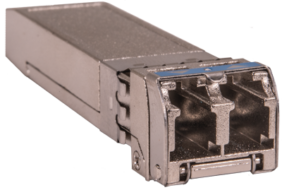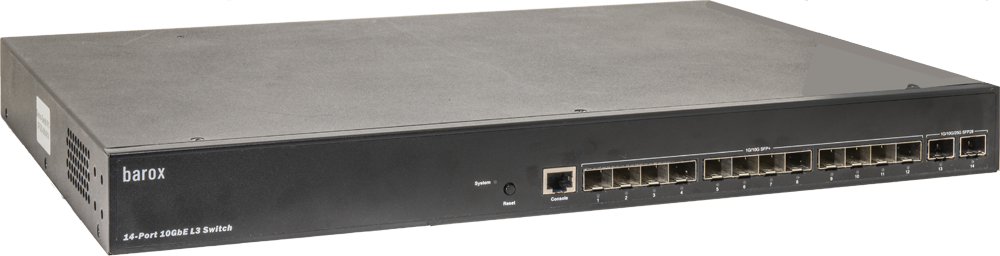
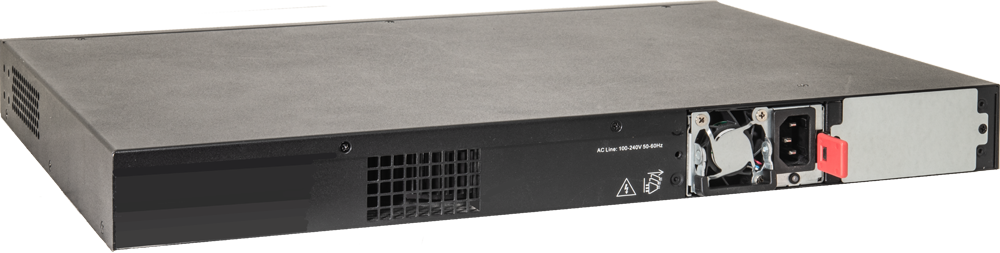
RY-LGSOTR38-14
- 19" L2 and L3 switch
- Fibre ports: 12 x 100M/1G/2.5G/5G/10G
- Fibre uplink ports: 2 x 1G/2.5G/5G/10G/25G
- Manageable, ring-configurable, static and dynamic routing
- OSPFv2/v3 and RIPv1/v2
- Controlled fan
- Redundant 230VAC power supply


This Layer 2 and Layer 3 switch has been specifically developed for applications with high data loads, such as Video over IP and video streaming, including in conjunction with multicast. Thanks to its high-speed 10G ports and two 25G uplink ports, the RY-LGSOTR38-14 is suitable for use as a core switch in larger networks. The redundant power supplies are also well-suited to this application. The switch features comprehensive security functions that protect both the switch itself and network traffic. Its extensive management capabilities enable it to meet even complex network requirements.
Product information
Short description
19-inch switch for core applications with robust security features
Special features
With its high port speeds of 12 x 10G and 2 x 25G, this switch is suitable for use as a core switch
Installation method
19"-mounting
Ventilation
Fan
Contents of the pack
19" mounting brackets
Self-adhesive feet
Mains cable
1 power supply unit; the second power supply unit for redundant power supply must be ordered separately
RJ45 to D-Sub 9 console cable
Quick Installation Guide (QIG)
Technical data
Redundant power supply possible via two power supplies
Hot-swappable
The management access methods can be individually disabled.
RIP v1/v2: Routing Information Protocol (RIP) is an internal routing protocol based on distance vector routing used within an autonomous system.
OSPF v2/v3 : OSPF is a link-state routing protocol. It is designed for internal operation in a single autonomous system. Each OSPF router maintains an identical database that describes the topology of the autonomous system. A routing table is calculated from this database by creating a shortest-path tree.
Supports up to 4K VLANs simultaneously (out of 4096 VLAN IDs)
Port-based VLAN
A port member of a VLAN can be isolated to other isolated ports of the same VLAN and private VLANs.
Private VLAN edge (PVE).
Private VLANs are based on the source port mask and there are no connections to VLANs. This means that VLAN IDs and private VLAN IDs can be identical.
Voice VLAN
The Voice VLAN feature allows voice traffic to be forwarded on the Voice VLAN.
Guest VLAN
The IEEE 802.1X Guest VLAN feature allows a guest VLAN to be configured for each 802.1X port on the device to provide restricted services to non-802.1X compliant clients.
Q-in-Q (double tag) VLAN
This can be used to set specific requirements for VLAN IDs and the number of VLANs to support.
802.1v protocol VLAN
Classifying multiple protocols into a single VLAN often forces VLAN boundaries that are inappropriate for some of the protocols. This requires the presence of a non-standard entity that forwards frames containing the protocols for which the VLAN boundaries are unsuitable between VLANs.
MAC-based VLAN
The MAC-based VLAN feature allows incoming untagged packets to be assigned to a VLAN, classifying traffic based on the source MAC address of the packet.
IP subnet-based VLAN
In an IP subnet-based VLAN, all end workstations in an IP subnet are assigned to the same VLAN. In this VLAN, users can move their workstations without having to reconfigure their network addresses.
Management VLAN
Management VLAN is used to manage the switch from a remote location using protocols such as Telnet, SSH, SNMP, Syslog, and so on.
Supports eight hardware queues.
Classification
Port-based: Traffic QoS by port.
802.1p: VLAN priority-based Layer 2 CoS QoS class of service is a parameter used in data and voice protocols to distinguish the types of payloads included in the transmitted packet.
DSCP-based Differentiated Services (DiffServ) Layer 3 DSCP QoS: IP packets can carry either an IP priority value (IPP) or a Differentiated Services Code Point (DSCP) value. QoS supports the use of both values because DSCP values are backward compatible with IP priority values.
Classification and re-marking of TCP/IP ACLs: QoS through ACL
Rate-limiting
Ingress policing
Egress shaping and per-port speed control
Scheduling
Strict Priority and Weighted Round Robin (WRR): Weighted Round Robin is a scheduling algorithm that uses the weights assigned to queues to determine how much data is emptied from a queue before it is moved to the next queue.
A private HTTPS key can be stored for management access.
User management
User rights can be freely set in up to 15 levels.
ACL
The switch allows up to 512 entries. Drop or rate restriction based on source/destination MAC/IP address or VLAN ID. Rules and conditions for incoming packets can be set per port. Rules include protocols, IP ports, and address ranges. Rules can be set using either the authorization or exclusion method. Criteria are: TCP/ UDP source and destination ports, 802.1p priority, Ethernet type, Internet Control Message Protocol (ICMP) packet.
Port Security
MAC address management per port and IP source guard: MAC address can be checked in combination with IP address.
Storm Control
Prevents traffic on a LAN from being disrupted by a broadcast, multicast, or unicast flood on a port.
RADIUS Authentication, 802.1X
Authorization and accounting, MD5 hash, guest VLAN, single/multiple host mode, and single/multiple sessions.
Supports IGMP RADIUS-based 802.1X
Dynamic VLAN assignment
TACACS+ authentication
The switch supports TACACS+ authentication. Switch as a client.
Secure Shell (SSH)
SSH secures Telnet traffic into or out of the switch, SSH v1 and v2 are supported.
Secure Socket Layer (SSL)
SSL encrypts HTTP traffic, providing advanced secure access to the browser-based management GUI in the switch.
HTTPS & SSL (Secured Web)
Hyper Text Transfer Protocol Secure (HTTPS) is the secure version of HTTP.
BPDU Guard
BPDU Guard, an extension of STP, removes a node that reflects BPDUs back into the network. It enforces the boundaries of the STP domain and keeps the active topology predictable by not allowing network devices behind a BPDU Guard-enabled port to participate in STP.
DHCP Snooping
With DHCP Snooping, the switch has a feature that acts as a firewall between untrusted hosts and trusted DHCP servers.
Loop Protection
Loop Protection prevents unknown unicast, broadcast, and multicast loops in Layer 2 switching configurations.
IGMP restricts bandwidth-intensive multicast traffic to requesters. Supports 1024 multicast groups.
IGMP Querier
IGMP Querier is used to support a Layer 2 multicast domain of snooping switches when no multicast router is available.
IGMP Proxy
IGMP Snooping with proxy reporting or report suppression actively filters IGMP packets to reduce load on the multicast router.
MLD v1/v2 Snooping
Delivers IPv6 multicast packets only to the required receivers.
Multicast VLAN Registration (MVR)
A dedicated, manually configured VLAN, called the Multicast VLAN, to forward multicast traffic over a Layer 2 network in conjunction with IGMP snooping.
Rapid Spanning Tree (RSTP), IEEE802.w
Multiple Spanning Tree (MSTP), IEEE802.1s
Ethernet Linear Protection Switching (ELPS), ITU-T G.8031
Ethernet Ring Protection Switching, (ERPS), ITU-T G.8032
Firmware (FW-Download)
You need an account to download the firmware. Please log in or register. Registration must be activated by us.
Software (SW-Download)
You need an account to download the software. Please log in or register. The registration must be activated by us.
Downloads

Complementary products
-
Compare
AC-SFP28-SR
SFP -
Compare
AC-SFP28-LR
SFP -
Compare
AC-SFP28-VK-2M
SFP -
Compare
AC-SFP28-VK-10M
SFP -
Compare
AC-SFP-BIA-FXME
SFP -
Compare
AC-SFP-BIA-FXSE
SFP -
Compare
AC-SFP-BIA-LXE
SFP -
Compare
AC-SFP-BIA-SXE
SFP -
Compare
AC-SFP-BIB-FXME
SFP -
Compare
AC-SFP-BIB-FXSE
SFP -
Compare
AC-SFP-BIB-LXE
SFP -
Compare
AC-SFP-BIB-SXE
SFP -
Compare
AC-SFP-FXMME
SFP -
Compare
AC-SFP-FXSME
SFP -
Compare
AC-SFP-LX-E-10
SFP -
Compare
AC-SFP-LX-E-20
SFP -
Compare
AC-SFP-LX-E-40
SFP -
Compare
AC-SFP-LX-E-70
SFP -
Compare
AC-SFP-SX-E
SFP -
Compare
AC-SFP-SXOM3-E
SFP